Showing posts with label Foraging. Show all posts

Monday, September 12, 2011

Cherry Bounce


I found these chokecherries last week. 
I've been doing a little research about foraging and edible wild foods lately.
These shiny black, pea-sized charms were glistening at me as I was walking along in search of walnuts.  I didn't find any walnuts on that trip, but I did harvest about a gallons-worth of these little guys.

I felt like I'd hit the jack-pot!
But, what to do with them.
There are only so many of them, only enough for one recipe.  My choices were 1.)chokecherry wine, 2.) chokecherry jam, and 3.) Cherry Bounce.

The first option sounds the yummiest, but I'm not sure I'm up for two wine experiments in one year, (I've got my beet wine maturing downstairs, one still fermenting - or something).  The second option sounds good, only we're up to our eyeballs in jams and jellies.  I opt for the third as it's the easiest and surest. It also seems like it will make great gifts at Christmastime.  I got this recipe from "The Foraging Gourmet" by Katie Letcher Lyle.


Prunus virginiana


I washed them, stemmed half of them, and washed them a couple more times.  Once all the leaves and other nature-bits were removed, I just put them through the juicer.
The photo above is what it looked like after juicing.
Kinda gross, ha?
Purple foam.
Well, that's something new.
Oh, and another thing, these tiny little chokecherry stones bounce.  Everywhere.


Well, a little reading suggests that straining the juice will yield a clearer product. 
I read that today. 
Yesterday, however, I decided to cook it down, which worked out okay.  I still skimmed off a bit of foam, but not as much as in the third photo.

I ran the chokecherries through the juicer twice, yet I still felt they looked moist.  So I scooped up a spoonful at a time into a double layer of cheesecloth and squeezed.  And squeezed.  Don't worry, if you've been brave enough to get this far, you already know this is a very messy recipe.  Wear an apron.  Hopefully my photo shows how nice and clear this last process came out.  Virtually no foam!  So I just poured it through a strainer into the rest of the batch.


I added my 3 pounds of sugar, according to the recipe, heated it just a tad - only enough for the sugar to dissolve, and stirring all the while so as not to scorch the pan.
At this point I turned off the heat and let it cool a few hours.

I returned later to another surprise.  It was quite thick and ice-like.  Reminiscent of a thin layer frozen, then easily broken with your spoon.
Well, I just mixed it up with the gallon of whiskey and pint of brandy and it's been fine ever since.  It's apt to burn your nose hairs off, so tell hubby.

After two weeks of stirring once per day, pour into pretty bottles and store until Christmas, when it's ready to drink.

Cherry Bounce

Stem & Pick over 1 gallon wild cherries
Mash into crock (only 12-20 seeds)
Add 3 pounds sugar
1 gallon good whiskey
1 pint brandy
Cover tightly
Let stand 2 weeks in dark closet
Strain and bottle


Have fun foraging, friends.  And be careful,  a little bit of bounce goes a long ways!


Friday, August 19, 2011

The Plum Trees Are Laden


We have a little plum tree in our back yard.
Some years it produces buckets-full,
so much that I call friends to come and help themselves.

Other years it seems to take a sabbatical.
This is one of those years,
which is okay with me.  After all,
we still have plenty of plum jam in the pantry.


Wild, tart roadside plums


Help with pitting buckets of plums (more in the fridge!)  2009

So, in homage to our faithful little tree,
I am sharing some recipes with you.
The kind that will carry you through the
long winter months to come.


For rosy apples, juicy plums,
And honey from the bees,
We thank You, Heavenly Father God,
For such good gifts as these.

~ Anonymous


Plum Chutney
yield 10-12 pints

10 cups chopped plum
4 cups cider vinegar
6 cups brown sugar
1 cup preserved ginger

 Tie these up in a cheesecloth:
3 cinnamon sticks
8-10 whole cloves
8-10 whole allspice
6 cardamom pods

Put ingredients into large nonreactive pot.
Simmer until thick, approximately 1-2 hours.
When thick, pour into hot, sterilized jars.
Adjust lids, not too tight.
Process 10 minutes.
Tighten lids.


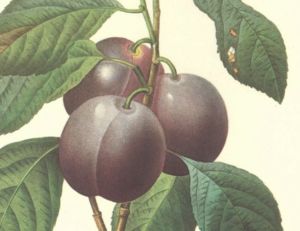
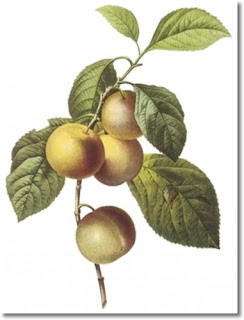
Botanical plum, Redoute


Another
Plum Chutney
yields 2 pints

3/4 cup cider vinegar
1 cup sugar
1 cup brown sugar
1-1/2 teaspoon hot pepper flakes
1/2 cup slivered, crystallized ginger
2 teaspoons pickling salt
2 teaspoons mustard seed
2 large cloves garlic, sliced thin
1/4 chopped onion
1 cup golden raisins
3-1/2 cups halved plums

In heavy, nonreactive pot, boil vinegar and sugars, dissolving sugar.
Add remaining ingredients, except plums.  Mix well.
Stir in plums.
Simmer, stirring, until thickened, about 50 minutes.
Ladle hot chutney into sterilized jars, leaving 1/4-inch head space.
Adjust lids.  Process.


Damson Plum, by Petula Stone


Pickled Plums
yields 6 quarts

6-1/2 pounds plums
5-1/2 cups cider vinegar
4 cups sugar
2 cinnamon sticks
6 small dried chili peppers
12 whole cloves
36 allspice berries
1 Tablespoon cardamom pods
24 thin slices fresh ginger

Prick each plum 3x.
In a large, nonreactive pot, bring vinegar and sugar to a boil.
Stir to dissolve sugar.
Add plums and reduce heat to low.
Let them cook gently until heated.
Put 1/3 of a cinnamon stick, 1 chili pepper, 2 cloves, 6 allspice berries, 1/2 teaspoon cardamom pods, and 4 slices of ginger into each sterilized jar.
Ladle hot plums into jars.
Cover with hot syrup, leaving 1/2-inch head space.
Seal and process.


Théo van Rysselberghe, Still Life with Plums, 1926


Pickled Plums With Red Wine
yields 4 quarts

6 pounds firm plums
1 teaspoon whole cloves
2 cinnamon sticks, broken
4 thin slices fresh ginger
4-2/3 cup sugar
3 cup red wine vinegar
3 cups red wine

Prick plums each 3x.
Tie spices and ginger into cheesecloth bag.
Put into nonreactive pot with sugar, vinegar, and wine.
Bring to a boil, dissolving sugar.
Reduce heat and simmer 5 minutes.
Remove from heat and cool.
Put plums into a bowl.
Pour cooled syrup over them and let rest 8-12 hours.
Drain off syrup into nonreactive pot,
add spice bag,
and bring to a boil.
Remove pot from heat, let syrup cool.
Pour over plums.
Let rest in syrup 8-12 hours.
Put all back into nonreactive pot.
Cook plums over low heat until skins begin to crack.
Transfer to sterile quart jars.
Boil syrup until thickened, then pour over plums. leaving 1/2-inch head space.
Seal.


Benjamin Roberts, Still life of plums with a cabbage white, 1862


Plum Schnapps
This doesn't take so many plums as the previous recipes.  I should be able to make this with our sparse crop this year.  Wouldn't it be delicious drizzled over a little vanilla bean ice cream?  Or splashed into a hot Christmas cider?


Use sweet and fully ripe plums - cultivated or wild cherry plums (Prunus cerasifera).
The plums must be fresh, firm, unwrinkled, smooth-skinned with no blemishes or soft spots.
You can make the schnapps in different ways.
You can use either the whole fruits, the whole fruits with small holes in them, or the whole fruits cut into halves - with or without the pits.
Using different methods, you get different results. It's a matter of taste which method you may want to use.
Personally I prefer the method with whole plums with small holes in them - I use a thick needle to pierce the skin to the pit.
You can use frozen plums. Just remember to defrost them in the vodka.

Direction:
  • Put 10-15 plums in a clean glass jar with tight-fitting lid.
  • Cover well with clear, unflavoured vodka - 40% alcohol content (80 proof).
  • Let steep for 3-6 months or more in a dark place at room temperature, 18-20°C (64-68°F).
  • Shake lightly and taste it from time to time.
  • Strain and filter your infusion into a clean glass bottle or jar with tight-fitting lid.
  • Store (age) for at least 2 months in a dark place at room temperature before serving.

Thursday, August 18, 2011

Crab Apples For Eating


Naturally, I was curious about this.  There is such an abundance of these neglected tiny fruits.  I can't say that I blame people, what a pain in the keester to pick a bushel of marble-sized produce.  However, we pick cherries, and wild plums, and raspberries...really we don't want to bother with the lowly crab apple.

Still, they're generally ripe after the raspberries and before their larger and more noble relatives, the real apples.  There are a few inquisitive and determined souls out there like me that just may be enterprising enough to attempt a crab apple recipe.  I did this with rose hips last year and now it's a favorite!

I haven't tried any of these yet, but I'm excited to begin a new food journey.

~    *    ~    *    ~    *    ~    *    ~


Crab Apple Jam
yields 8-9 pints

4 cups apple pulp
2 Tablespoons lemon juice
1-1/2 packages powdered pectin
8 cups sugar

Put apple pulp and lemon juice into a large, nonreactive pot.
Bring to a boil.
Add pectin.
Return to a boil.
Slowly add sugar and stir, bringing to a boil.
Boil for 1 minute, or until jam sheets off the spoon.
Pour into hot, sterilized jars.
Cover and process 5 minutes.


Pickled Crab Apples
yeilds 2 pints

1 2-inch cinnamon stick, broken
1 teaspoon allspice berries
1/2 teaspoon whole cloves
1 1/4 cup sugar
3/4 cup water
1 cup cider vinegar
1 1/2 pound crab apples, stems on

Tie the spices into a cheesecloth bag.
Put into a nonreactive pot with:

sugar
water
vinegar

Bring to a boil, stirring to dissolve the sugar.
Remove the pot from heat and let syrup cool.
Pierce each crab apple through with a large needle, to keep from bursting.
Put them into the pan of cooled syrup and slowly bring to simmer.
Cook until tender and translucelt, about 15 minutes.
Remove from heat.
Let rest 12 to 18 hours.
With a slotted spoon, remove the crab apples from the syrup.
Pack into hot, strerilized pint jars leaving 1/4-inch head space.
Remove the spice bag.
Boil syrup.
Pour over fruit.
Seal jars.


~    *    ~    *    ~    *    ~    *    ~


Crab Apple Liqueur
From Recipe Secrets

4 quarts crabapples, washed,cored and quartered
4 cups sugar
3 cups vodka

Fill 1 (4-quart) mason jar with tight-fitting lid with prepared crabapples.
Add the 4 cups of sugar and three cups of vodka.
Store the jar on its side, turning once every day for 16 days to help the sugar to dissolve.
After 16 days, filter out the fruit bits and bottle.


~    *    ~    *    ~    *    ~    *    ~


Cedar Waxwing on the Crab Apple, Sandra Cointreau

Crab Apple Hot Pepper Jelly
From Recipe Secrets


2 lbs crabapples
1 1/2 cups water
red wine vinegar
3 3/4 cups granulated sugar
1 cup sweet green bell peppers
1/3 cup hot peppers (mix and match hot peppers for color and preferred degree of heat)


In a Dutch oven, combine crabapples with water.
Cover and bring slowly to simmer.
Cook until crabapples are very soft.
Pour into a colander lined with a square of dampened cheesecloth and placed over a deep bowl.
Weight down with a saucer and heavy can.
Let stand until dripping stops.
Discard pulp.
Pour collected juice into a liquid measure.
Add enough vinegar to make 3 cups.
Combine in a saucepan with sugar.
Bring to a boil, stirring constantly.
Add peppers, then boil briskly for 8 to 10 minutes or until set.
Stir for 7 minutes to prevent floating peppers.
Pour jelly into hot, sterilized 8-ounce canning jars.
Seal with two-piece canning lids.
Let cool, then refrigerate.
For long-term unrefrigerated storage, process in boiling water bath for 5 minutes immediately after sealing jars.

NOTE: To test for set, remove pan from heat.
Dip a cold metal spoon into the liquid and hold well above the steam.
Turn spoon sideways and let liquid run off.
When it forms two drops that run together and drip from edge of spoon, jelling point has been reached.


~    *    ~    *    ~    *    ~    *    ~


Goldfinch in a Crab Apple Tree, Janet Zeh


Crabapple Schnapps
From Danish Schnapps recipes


Use freshly picked and fully ripe crabapples. They are fully ripe when the pits have become dark brown.
You can use almost any species - so start with your favourite one, then try some other species.
However, Siberian Crabapple (Malus baccata)and also Chinese Apple (Malas prunifolia) are two species that are highly recommended.
Direction:


  • Wash 10-20 crabapples and cut them in halves. Leave the skin on.
  • Put them in a clean glass jar with tight-fitting lid.
  • Cover with clear, unflavoured vodka - 40% alcohol content (80 proof).
  • Let steep for 8-10 weeks or more - in a dark place at room temperature, 18-20°C (64-68°F).
  • Shake lightly and taste it from time to time.
  • Strain and filter your infusion into a clean glass bottle or jar with tight-fitting lid.
  • Store (age) for a couple of months in a dark place at room temperature before serving.


Note: If for some reason you are not satisfied with your infusion, there are ways to adjust both taste and flavours:


Too strong-flavouredIf your infusion is too strong-flavoured and overwhelming you can just dilute it with the same kind of spirit you used as base.
Allow to settle for a couple of days or more before serving. Taste it to find out.

Too weak-flavouredIf your infusion is too weak-flavoured you can enhance the flavours by adding a little, little bit of sugar.
True Danish flavoured schnapps should not contain more than 10-15 grams sugar per liter. But of course, you can add as much as you want to suit your own taste.
You can add the sugar directly, but because sugar is more soluble in water than in alcohol, it's usually better to make a simple sugar syrup...
...and add it to your infusion little by little.
Allow to settle for a couple of days. Taste it again, it might need some more.
Never use artificial sweeteners - NEVER! You will ruin the taste.

Remember to keep your schnapps bottle tightly closed and in a dark place before and between servings.


~    *    ~    *    ~    *    ~    *    ~

The Crab Apple Fairy, Cicily Mary Barker

Crabapple Butter
From Recipe Secrets

6 cups sieved crabapple pulp
Grated peel and juice of 1 orange
2 cups sugar, optional
1 tsp cinnamon, optional
½ tsp cloves, optional
¼ tsp nutmeg, optional

Combine pulp with orange peel and juice in a Dutch oven.
Place over high heat and bring to a boil, stirring constantly.
Reduce heat to medium and boil gently, stirring frequently to prevent scorching, until mixture thickens to desired consistency.
Stir in sugar and spices, if desired, and return mixture to a boil, stirring constantly.
Ladle into hot sterilized half-pint jars, leaving ¼ inch headspace.
Remove air bubbles with a narrow rubber spatula or plastic knife.
Add additional crabapple butter, if necessary, to maintain headspace.
Wipe jar rims thoroughly with a clean damp cloth.
Seal and process in a boiling water bath. Process for 15 minutes
.
Crabapple butter may also be cooled and frozen for up to one year.

Yields 6 half-pint jars.


Now I'm off to beg my generous neighbor for some crabapples...

Monday, July 25, 2011

Raspberries are Ripe!


We've been harvesting our raspberries every other day now for a couple of weeks.  What a glorious time of year!  Who doesn't like rapberries?

We've been freezing what we pick until I had enough for a batch of jelly.  Today I made 9 pints and we can hardly wait to eat it up!


Something else thats ripe this year is peaches.  Make a smoothie!

Raspberry Peach Smoothie
1/2 c raspberries
1 c sliced peaches
1/2 c plain yogurt
1 Tbsp honey

You can make a smoothie out of anything that sounds good to you.  Use milk, almond milk, coconut milk, ice chips, plain yogurt, vanilla yogurt, etc.  Your only limit is your imagination.  Of course, there are plenty of recipes to be found to inspire you.  Feel free to tweak what you like.  Perhaps add a spice or two.  A pinch of cinnamon, cayenne, coriander, or whatever goes with your fruit selection.  Learning about the health benefits of herbs and spices helps us to be in better control of our nutrition.

A Raspberry Cooler sounds good on a hot July afternoon.
2 pints raspberries
1 sliced lemon
1/2 tsp vanilla
1/4 c sugar

Combine in a double boiler over simmering water.
Cook about 12 min until raspberries have released most of their juices.

Strain and discard solids.
Cool.
Pour 1/4 of this syrup into glass filled with ice.
Top with 1 cup selzer.
Serve with lemon wedge.

This Baked Raspberry Custard, also from Martha Stewert, looks delicious and not too difficult.
  • 1/4 cup (1/2 stick) unsalted butter
  • 3/4 cup whole milk
  • 3 large eggs
  • 1/2 cup plus 1 tablespoon sugar
  • 1/2 cup all-purpose flour
  • 1/4 teaspoon coarse salt
  • 1/2 teaspoon pure vanilla extract
  • 2 cups raspberries (about 9 ounces)
  1. Preheat oven to 400 degrees.
  2. In oven, melt butter in a 9-inch pie plate, about 6 minutes.
  3. In a blender, combine milk, eggs, 1/2 cup sugar, flour, salt, and vanilla. Add melted butter and blend mixture until smooth, 30 seconds.
  4. Distribute berries evenly in pie plate and pour batter over top. Sprinkle with 1 tablespoon sugar and bake until slightly puffed and just set in middle, 20 to 25 minutes. Heat broiler and broil until top is deep golden brown, 2 to 3 minutes. Serve warm.


Whatever you do, be sure to get'em before they do!


Friday, March 18, 2011

Asparagus & Rhubarb, Coming in May

For those of us living in these nothern climates, spring is an extremely exciting time.  The autumn fruits aren't what they were a few months ago, prices are up as well. 

We're pretty much down to the root vegetables and winter squash, and lets face it, even the grown-ups aren't thrilled about it.

Seed catalogues are dog-eared and marked throughout with zealous pens and hilighters.  Our exceptionally industrious and frugal neighbors have happily sacrificed a few weeks' use of their kitchen tables and countertops for the promise of good things to come.  


Nasty old man Winter is down for the count and we prepare to dance barefooted upon his blessed slumber.

Ahh, spring.


In May the bright and beautiful rhubarb and asparagus will be in season for us.  Let's plan...


Quantity:
An average of 24-1/2 pounds is needed per canner load of 7 quarts;
an average of 16 pounds is needed per canner load of 9 pints.
A crate weighs 31 pounds and yields 7 to 12 quarts÷an average of 3-1/2 pounds per quart.
Quality:
Use tender, tight-tipped spears, 4 to 6 inches long.
Procedure:
Wash asparagus and trim off tough scales.
Break off tough stems and wash again.
Cut into 1 inch pieces or can whole.
Hot Pack:
Cover asparagus with boiling water.
Boil 2 or 3 minutes.
Loosely fill jars with hot asparagus, leaving 1 inch head space.
Raw Pack:
Fill jars with raw asparagus, packing as tightly as possible without crushing, leaving 1 inch headspace.
Add 1 teaspoon of salt per quart to the jar, if desired.
Add boiling water, leaving 1 inch headspace.
Adjust lids and process.
Recommended Process (Hot and Raw Pack)
1) Dial-gauge Pressure Canner
Pints÷30 minutes 11 PSI Quarts÷40 minutes 11 PSI

2) Weighted-gauge Pressure Canner
Pints÷30 minutes 15 PSI Quarts÷40 minutes 15 PSI


* * * * * * * * * * * * * * * * * * *

Also there are some very good, step by step instructions, with illustrations on Pick Your Own.org.  Try, too, Canning USA.


Use this for asparagus soups and sauces.


A good investment.  These come in different sizes.


* * * * * * * * * * * * * * * * * * *

Quantity:
An average of 10½ pounds is needed per canner load of 7 quarts;
an average of 7 pounds is needed per canner load of 9 pints.
A lug weighs 28 pounds and yields 14 to 28 quarts—an average of 1½ pounds per quart.

Quality: Select young, tender, well-colored stalks from the spring or late fall crop.

Procedure:
Trim off leaves.
Wash stalks and cut into ½ inch to 1 inch pieces.
In a large saucepan add ½ cup sugar for each quart of fruit.
Let stand until juice appears.
Heat gently to boiling.
Fill jars without delay, leaving ½ inch headspace.
Remove air bubbles.
Wipe jar rims.
Adjust and process.

Recommended Process:
Boiling-Water Bath
Pints or Quarts—20 minutes
Process directions for canning rhubarb in a dial-gauge or weighted-gauge canner are given at the end of this section.


For recipes and links, try these blogs Seasonal Onterio Food and Stocking the Larder.

Saturday, January 29, 2011

Rose Hip and Rhubarb Jam

I was researching ideas for old-fashioned summer jams, something different I could do with my rhubarb, when I stumbled onto this particular recipe.  The name alone sounded lovely, and once I read the ingredients I knew I had to try it.  It was the addition of the lemon rind that really made my mouth water.  This is certainly not the easiest jam for which to prepare.  Harvesting enough tiny hips is a long, tedious task on a late summer's afternoon.  Preparing them is yet more laborious indeed.  Once you've managed to achieve your monumental enterprise, the rest is standard.  Until, of course, you plop your first dollop of this jewel upon a perfectly buttered toast.  These jars will no longer represent hours of summer toil and sweat, but now your guarded golden, rosy reward. 


Every one's favorite, I have actually been reprimanded by my children for giving this as gifts!  Give it a try, you'll become as obsessed as we.


1 cup rose hips, slightly under-ripe
4 cups diced rhubarb
1 cup water
1/4 teaspoon salt
2 cups sugar
1 tablespoon grated lemon rind


Cut rose hips in half and remove seeds with knife point.
Combine rose hips, rhubarb, water, and salt, and boil 1 minute.
Add sugar and lemon and boil 1 minute.
Remove from heat and pour into hot, sterilized jars.
Process in boiling water bath.


~ Cooperative Extension Service, University of Alaska

Rose Hips

About Me

My photo
As long as I'm on this journey, rambling through life's exhilarating highs and trudging heavily amongst it's incapacitating lows, I might as well share whatever may be gleaned from my little bits of wisdom and my many missteps. No room for judgment from this broken mama. I'm writing from my heart: raw, open, messy, but saved. And I'm still thanking God!